Showing posts with label the cure for love. Show all posts

Thursday, 9 February 2012

Work for Sale

Phew, it's been a busy couple of months! A proper update to follow, but first (although I realise it may be a little late to post this) I will be selling some of the pieces from The Cure for Love at:


Through the talented, enterprising, generally rather wonderful lady who runs Significant Seams.


That's in Wood Street Indoor Market, Walthamstow, (London), this Saturday, from 10am - 5:30pm.


Check out the Market's website; it's going to be quite the day!

Sunday, 18 December 2011

Love at t'Mill

This may one of my final blog posts (at least for a little while, until I've figured out my trajectory for the final practical project of the year!) This is also one of my last weeks in The Stow for a wee bit, and I must admit I'll miss it. In early January I'll be travelling back down to Falmouth, to deliver a presentation on The Cure for Love, bringing this project to a close.

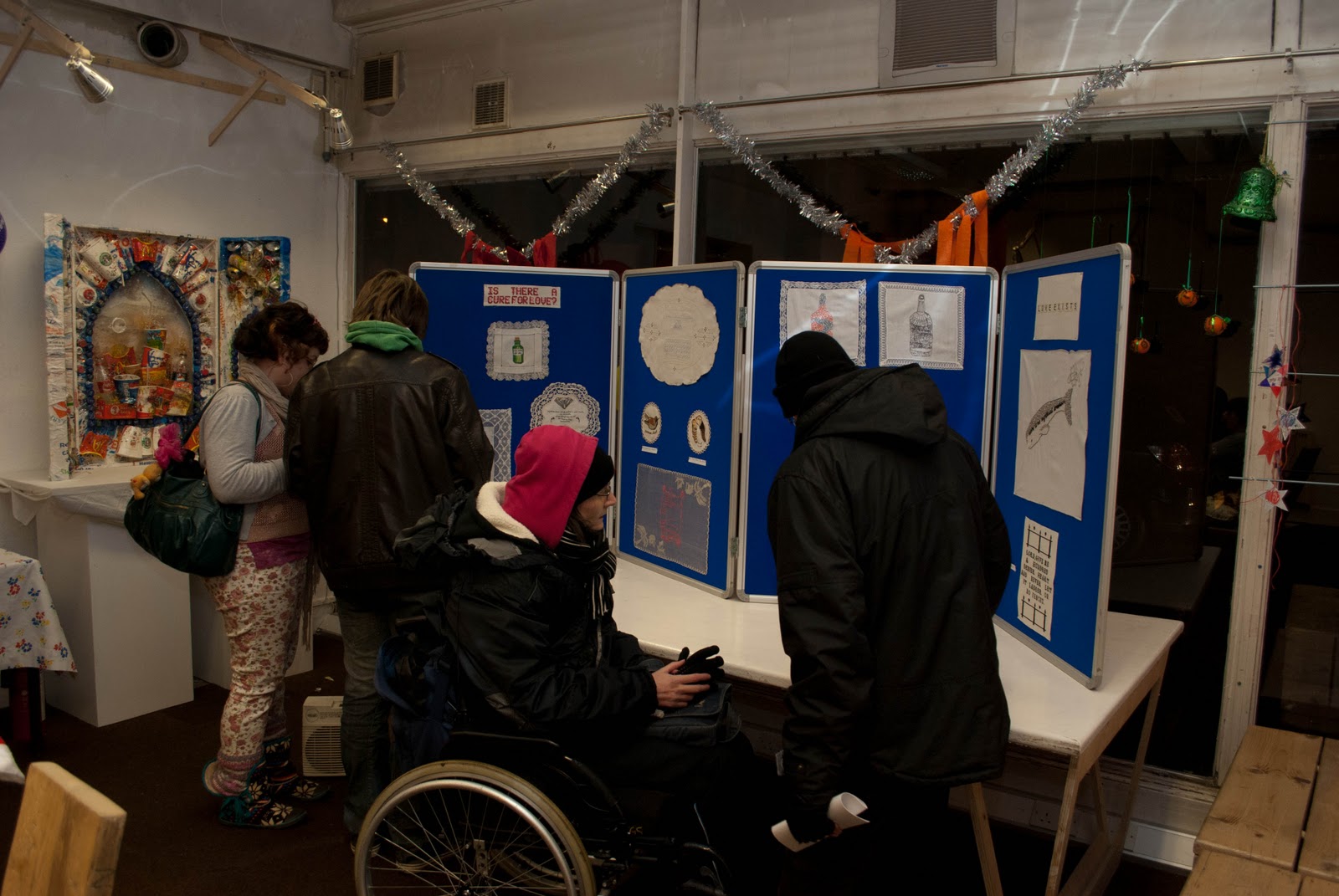
The celebratory end of The Cure for Love happened last night, with a joint exhibition and embroidery workshop at The Mill community centre, where Tina and I held our Is There a Cure for Love? workshop in October. 

My embroideries were displayed with a booklet of all the texts I wrote throughout The Cure for Love. Each embroidery was numbered according to its corresponding text in the booklet.


In the workshop I offered two options; either make a love potion or a cure for love of your own concoction. It was enheartening to an old romantic like me that most participants chose to make a love potion; perhaps we're all more sentimental and optimistic around Christmas time?

Some of the ingredients of these, er, "love potions" were a little suspect, though:


Looking at the photos, it seemed like everyone enjoyed themselves; they've certainly all got smiles on their faces (me included!) I'm very lucky to have such supportive friends and family.

We even had a number of curious locals in, eager to have a gander and try their hand at stitching.


It was a lovely evening, and a very fitting end to The Cure for Love.

I suppose all that remains is for me to wish everyone a very Merry Christmas! Until next time (whenever that may be!)


Monday, 28 November 2011

"A Disparate Patch-work" - Writing and Sewing


In her essay Sew to Speak: Text and Textile in Eudora Welty, Geraldine Chouard describes the process of writing as "editing "with needles and pins," shifting and assembling textual fragments, in a fashion very similar to patch-work quilting."

Indeed, it could be said that my own writing practise is akin to "patch-work"; I have assembled the texts I have used in The Cure for Love out of various "scraps of material" garnered from different poems and short stories.

Not only that, but the various art forms explored throughout The Cure for Love (text, sound art, embroidery, and, in the near future, video) are combined together into a "patchwork quilt", comprising the project.

I almost always write, like Chouard, in "strips - paragraphs here, a section of dialogue, and so on."

Chouard goes on to explain that "A text is always a second-hand piece, made of words which have had a life of their own in previous arrangements, as are the fragments of a patchwork quilt which have served other purposes and which, stitched together in a particular fashion, form new patterns."

I concur; to paraphrase Cixous, when we write, we collaborate with all writers who have gone before us; all texts; all language.

Cixous writes of "a spokesperson I, the social I who votes, who represents me. I have an I who escapes me. I have an I who answers for me. I have an I who knows the law. The I who writes gives speech to all the other Is." Is this "I" not the same as Freud’s “ego” ?

The "speech" which the "I who writes gives (...) to all the other Is" is thus the canon of writing passed down to the "I who writes" over the passage of time. Through drawing this conclusion, Cixous arrives at an ideology in her own writing of never asking herself "who am I?" (qui suis-je?)", but instead asking herself  " “who are I?” (qui sont-je?)"
All writing, therefore, is patch-work.

"To speak is to thread and the thread weaves the world"

Liz Whitehouse introduced me to this gorgeous poem by Cecilia Vicuña (translated by Rosa Alcalá). Thanks Liz!


Word & Thread

Word is thread and the thread is language.
Non-linear body.
A line associated to other lines.
A word once written risks becoming linear,
but word and thread exist on another dimensional plane.
Vibratory forms in space and in time.
Acts of union and separation.
*

The word is silence and sound.
The thread, fullness and emptiness.

*

The weaver sees her fiber as the poet see her word.
The thread feels the hand, as the word feels the tongue.
Structures of feeling in the double sense
of sensing and signifying,
the word and the thread feel our passing.

*
Is the word the conducting thread, or does thread conduct the word-
making?
Both lead to the centre of memory, a way of uniting and connecting.
A word carries another word as thread searches for thread.
A word is pregnant with other words and a thread contains
other threads within its interior.
Metaphors in tension, the word and the thread carry us beyond
threading and speaking, to what unites us, the immortal fiber.
*
To speak is to thread and the thread weaves the world.

*
In the Andes, the language itself, Quechua, is a cord of twisted straw,
two people making love, different fibers united.
To weave a design is pallay, to raise the fibers, to pick them up.
To read in Latin is legere, to pick up.
The weaver is both weaving and writing a text
that the community can read.
An ancient textile is an alphabet of knots, colors and directions
that we can no longer read.
Today the weaving no only "represent," they themselves are
one of the being of the Andean cosmogony. (E. Zorn)
*
Ponchos, llijllas, aksus, winchas, chuspas and chumpis are beings
who feel

and every being who feels walks covered in signs.
"The body given entirely to the function of signifying."
René Daumal
A textile is "in the state of being textile": awaska.
And one word, acnanacuna designates the clothing, the language
and the instruments for sacrifice (for signifying, I would say).
*

And the energy of the movement has a name and a direction: lluq'i,to the left, paña, to the right.
A direction is a meaning and the twisting of the thread
transmits knowledge and information.
The last two movements of a fiber should be in opposition:
a fiber is made of two strands lluq'i and paña.A word is both root and suffix : two antithetical meanings in one.
The word and the thread behave as processes in the cosmos.

The process is a language and a woven design is a process re-
presenting itself.
"An axis of reflection," says Mary Frame:
"the serpentine
attributes are images of the fabric structure,"
The twisted strands become serpents
and the crossing of darkness and light, a diamond star.
"Sprang is a weftless technique, a reciprocal action whereby the
interworking of adjacent elements with the fingers duplicates itself
above and below the working area."

The fingers entering the weave produce in the fibres
a mirror image of its movement, a symmetry that reiterates "the concept
of complementarity that imbues Andean thought."
*
The thread dies when it is released, but comes alive in the
loom:
the tension gives it a heart.
Soncco,
judgement and reason, the wood's core, the stem's central
fiber.
The word and the thread are the heart of the community.
In order to dream, the diviner sleeps on fabric made of wik'uña.
is heart and guts, stomach and conscience, memory, judgement and reason, the wood's core, the stem's central
fiber.
The word and the thread are the heart of the community.
In order to dream, the diviner sleeps on fabric made of wik'uña.

Sunday, 27 November 2011

My exhibition at The Mill

If you're in London, I would love to see you there!

Love Potion Number 1

Remember the potion book I shared with you in a previous post? Well, I've spent the past few days stitching up the love potion from it (apologies for the long absence; I've had two friends to stay pretty much consecutively, and consequently have been quite busy!)

The tiny stitches are practically illegible; unintelligibility is a concept I have previously been interested in in terms of the spoken word in sound art; censorship, self-censorship, a lack of transparency of communication, stuttering, irritating modern-day “thinking aid” fillers such as “Yeah” and “Like”, etc. I think illegibility can sometimes work when done intentionally, for example in this case with the sprawling handwriting of young children, with its invented and secret languages. Also, it only adds to the mystique of potion-making!


Yesterday an aforementioned friend who was staying with me and I visited the Wellcome Collection in Euston, one of my favourite London galleries. The exhibitions are often a fascinating combination of art and science. The current exhibition  which I was most interested in, however, was a bit of a departure from the scientific side of things; titled Charmed Life: The Solace of Objects, it was curated by the artist Felicity Powell (who I think may just be my new favourite artist!)

Powell selected talismanic objects from the collection of Edwardian amateur folklorist Edward Lovett (which comprised 1400 amulets). Despite rising to the rank of Chief Cashier at the City of London's Bank of Scotland, Lovett had a keen interest in the superstitions of working class Londoners. He began collecting charms which these Londoners carried for luck or protection, amassing the huge collection from which Powell has drawn the exhibition.

The sea horses shown above, for example, were made in Venice and carried by Londoners to bring good luck.

A coil of wire from Ceylon with "length equal to the height of a person" was intended to ensure a successful resolution to any request by the person in possession of it. Alongside the wire were displayed "Gemstones of poor quality, given by Gem-miners", also intended to bring good luck.

One of the most aesthetically interesting installations was comprised of a huge selection of beautifully laid-out charms, votives, and amulets, to ward off "nightmares" etc. These included glass acorns, lucky horse-shoes, glass slippers, tin hearts, carved coral and bone, fossils, and metal crosses and phalluses. The (rather blurry and wonky)scan below shoes how this installation was laid out:


Powell also made work in response to the exhibition; ranging from an etched coin "Against insomnia, for sleep, against amnesia, for memory", with a scene of clouds gathered over the sea. This put me in mind of relaxation techniques for sleep; "whale song", and imagining that "you are on a beach..."

Powell's current practise mainly focuses on wax "amulets" carved into mirror backs. These dream-like scenes are evocative of folkloric art. The short films Powell had created for the exhibition truly captivated me; they were full of the illusion and "magic" with which the objects Powell curated were imbued. In one, Powell "strokes" wax on to a mirror back, and hands appear; in another, "beams" of coral-coloured wax dissolve into flames.

Sleight of Hand, video, 7 minutes, 2011

Folkloric art and charms is definitely a practise I will be looking into towards the time of my CAP (the final performance/installation/presentation of my degree). I feel it is relevant for The Cure for Love, however, due to my focus on love potions and seeking a "cure" for love.

Sunday, 20 November 2011

Blogged by Stitch Therapy

Stitch Therapy (aka Emma Parker) did a post on some very talented needlework artists, and included one of my pieces; I'm very flattered to be featured alongside the likes of Matthew Cox! Thanks, Emma!

Monday, 14 November 2011

Bramble Snagged Heart


This is my penultimate collaboration with composer Joe Donohoe. This one, Bramble Snagged Heart, strikes a middle ground between Kiss the Book and The Alchemist; the text has some of the cynicism of the former combined with the earnest love poetry of the latter. With the sound of the piece, I was aiming for a recreation of the atmosphere of Walthamstow Village at night; therefore Joe used the sound of wind running through trees, traffic passing, and a church or clock bell. He also used the sound of cars beeping in traffic to highlight the phrases "terrified in headlights" and "roadkill on the motorway" We were also aiming for a "wintry" effect, which I think Joe has achieved through the guitar in the piece. He also created a "jarring" effect with the guitar which is played during the phrase "wolf bites down my neck", and then repeated for the line "I deep plum bruised".

I really enjoy the contrast of the three pieces; the first, with minimal music, used chord harps, the second, simulated tuned percussion, and this, the third, guitar.

Here's the text of Bramble Snagged Heart:

Bramble Snagged Heart

Love is no mythical creature my dearest darling, but just before I stumbled into you I would stumble into blind backstreet alleys for the piss-promise of male, malingering company, for the price of cheap white rum, baptised, doused in the stuff, yet all doe-eyes and fuzzy-kneed, fuzzy knees, knees a-trembling, brand spanking newborn and just mewling out for love, terrified-in-headlights. Roadkill. O don’t you know that is how love feels now? Awake from shrieking sunbleached streaky sleep and roadkill on the motorway is more, more than beautiful. Life is more than bearable.
So, sweetheart:
Invent me, mark out my borders with your fingertips, write me into the periodic table. Name me after yourself.
 All I ever used to want was his, oh hell, anyone’s wolf bites down my neck, inky keepsake emblems, and a spring in my step. Because I was brand-new, white and slippery as bathtubs and as yet unblemished... but... I bit off more than I could chew, I deep plum bruised. A bathtub heart covered in hairline cracks. So I prayed to no one in particular;

(Lord) give me a hundred denier heart
To keep the cold out
To keep lost souls out
And never let it ladder on no fences
(And when it’s held up to the light
Let it show no ladders)

Except...
You snagged on my thighs and tugged me to attention,
Snuck
Into my heart,
My opaque winter heart, suddenly
Unstoppered
It
And
To my surprise
What a gentleman you proved
I am no lady but
I only want a gentleman
And a gentleman
Is what I’ve found.

For the accompanying embroidery, I illustrated one of the opening lines of the piece, "Love is no mythical creature". I chose to illustrate this phrase with a narwhal, as in the Middle Ages narwhal tusks were believed to be unicorn horns. Unicorns are mythical creatures; narwhals, however, are not, and neither is love (despite what the cynical amongst us might have you believe).

This phrase is also a reference to Tao Lin's short story Love Is A Thing On Sale For More Money Than There Exists, which contains the following quote: "Though if love was an animal, Garret knew, it would probably be the Loch Ness Monster. If it didn’t exist, that didn’t matter. People made models of it, put it in the water, and took photos. The hoax of it was good enough. The idea of it. Though some people feared it, wished it would just go away, had their lives insured against being eaten alive by it."


I used French knots to create dense texture and the spotted pattern of the narwhal's back.

Thursday, 3 November 2011

Love Exists

Love Exists is an online project envisaged by the artist Scarlett Barry, conducted through the social networking site LiveJournal, beginning in July of 2005. Barry encourages members of the Love Exists LiveJournal community to write the phrase "on walls. Carve it in trees. Paint it on our bodies and scream it out loud."


A photograph by Barry to accompany the LiveJournal community
 LiveJournal may since have fallen out of favour with bloggers, but the idea of Love Exists lives on in Flickr and Facebook groups.

I really like the idea of spreading a simple message of love and hope globally.


For example, the above photograph was taken by LiveJournal user darkestblue22 in the Sahara Desert.

Love Exists bears a close resemblance to You Are Beautiful,a street art project operating out of Chicago, which attempts to spread this simple, positive message globally "by any means necessary except through commercial use".

Here's what the project's creators have to say about it:

"You are Beautiful is a simple, powerful statement which is incorporated into the over absorption of mass media and lifestyles that are wrapped up in consumer culture.

The intention behind this project is to reach beyond ourselves as individuals to make a difference by creating moments of positive self realization. We're just attempting to make the world a little better."

You Are Beautiful has truly become a global project, as evidenced by the photographs below; the first was taken in Bailey's Head, Antarctica, and the second in Cape Town, South Africa.


I decided to contribute to the Love Exists project through the most global of networks; the internet.


I took this Polaroid several years ago when I first became aware of the Love Exists project; in fact, when I still had a LiveJournal account. I shared the photograph on LiveJournal through the group the-polaroids, and of course the Love Exists group. I have since uploaded it to Flickr, to share the message with a wider audience.

The message fits seamlessly into the Cure for Love project, and thus I decided to render it in stitch. I chose cross stitch for a bit of variation from all the straight embroidery I've been doing lately, and also because cross stitch gives such a regular and crisp appearance to text, and so works perfectly with the scrabble tiles. The design is based loosely on the Polaroid. I really like the simplicity of the piece. I've also shared it on Flickr and submitted it to the Love Exists Flickr group.


Wednesday, 19 October 2011

"Is There A Cure For Love?" Embroidery Workshop @ The Mill

Tonight was mine and Tina's embroidery/love potion making workshop at The Mill community centre in Walthamstow. There wasn't a huge turn-out, but to be honest, considering it was an introductory session I was glad anyone turned up at all!

We took ingredients, negative and positive, from failed relationships, and stitched them on to ribbon, adding them to bottles to make "broken" potions. We then stitched ingredients to positively re-balance the potions, to find a "cure for love". The workshop was very therapeutic, both in its subject matter of taking something broken and making it beautiful again, and in that sewing itself is a therapeutic action (something Joetta Maue mentioned in my interview with her).


Tuesday, 18 October 2011

Post Post Post Post Post Post Modernism

I've just come in from the theatre to find that my Post Post Post Post Post Post Modernism cross stitch was featured on the British University Artists website. Also, Angeliki Goude of the blog domesticatedbee mentioned my interview with Joetta Maue in this blog post. Finally, the East London Craft Guerrilla gave me a little shout out for my blog post featuring an interview with their founder Debbie.

My embroidery/love potion making workshop is tomorrow. I'm excited but nervous!

Well, with that, and a scan of Post Post Post Post Post Post Modernism, I bid you good night.

Interview with Debbie of the East London Craft Guerrilla

I promised more on Walthamstow's arts and crafts scene, so here's an interview with Debbie, founder of Walthamstow's East London Craft Guerrilla. Thanks Debbie!

Founders of the East London Craft Guerrilla

Do you feel there's something of a craft revival in Walthamstow, and the wider world, at present?
Definitely, it's been going on for quite a few years now.

Do you feel any connection with Walthamstow's craft history? (I'm thinking of William Morris in particular)
Very much so. I tend to think that if William Morris were around that he'd very much like and agree with our principals as we have based our manifesto on his campaign of making craft accessible to the masses. I think he'd fit in very well and be happy to associate with us....I'm sure he would have been one of the Craft Guerrilla founding members!

Walthamstow isn't exactly as hip as Hoxton or Shoreditch! Do you feel this is a hindrance or a help to your cause?

In a way it's a help as we get a captive audience.... there's not much to do out in the suburbs!

Crafters at a Craft Guerrilla night
 Although he is a very different craftsman to you, Grayson Perry's studio is in Walthamstow. Do you admire his work/is he an influence on you?
Actually we do have lots in common as I also am a ceramicist. I absolutely love his work....though I can't say it has influenced me.

Are you involved in the E17 Art Trail?
Usually yes. I have participated in pretty much all trails since the beginning as both an individual artist and/or under the Craft Guerrilla collective banner. The Art Trail is one of the events we look forward to participating in as we can organize larger scale events and really get the community involved.

Walthamstow is "sandwiched" between the two natural spaces of Epping Forest and the Lee Valley; does this influence show at all in your own work and/or that of the Craft Guerilla?

Though I love nature I'm pretty much a "city girl". My main influences come from the city, life in the capital and its people. I love nature but I find the hub bub and energy of the city more inspiring and relevant to my work with Craft Guerrilla as we work mainly with urban dwellers and the intention is to get them making so we need to offer projects/work which they can understand and relate to.
A finished cross stitch button brooch, one of the kits which was offered at a Craft Guerrilla night

What is your particular practise as part of the Craft Guerrilla?
I'm a dab hand at all sorts of craft disciplines, though my weaknesses are knitting and crocheting, but I'm willing and wanting to learn everything I can. I would say that my favourite craft disciplines are anything stitched based so cross stitching, embroidery, sewing and anything with fabrics. I am also the founding member and the main organizer so a lot of my time is spent doing the bulk of the work which can be anything from planning an event, doing the PR, making the craft kits to chosing the play list for our market event. But the main intention is to have Craft Guerrilla as not only a platform for designer makers to sell their wares but also to serve as an educator and to create a wider creative community.

A participant knitting at a Craft Guerrilla night

0Why did you set up the Craft Guerrilla?
To begin with it started as a back lash to not having adequate craft events in the area. I had participated in other fairs in Walthamstow, and all over London, and it always left me feeling that the organizers weren't really into this because they loved craft but were involved solely because they wanted either to make money off designer makers by renting over priced stalls or to massage their own ego. Also they were very poorly subscribed to as the majority of makers were of very low quality. There's nothing wrong with having plastic beads on a string but it's not craft! Having quality, well made, well designed products is really important as if you are offering people an alternative it needs to be as good or better then what is available on the High Street.

Even though there is a huge artistic and craft community in Walthamstow it's very insular and elitist so having participative craft events like our DIY craft nights which are open to the public is our way of bringing awareness to the importance and value of hand made goods. It's also a good excuse to socialise!


My friend Kat and myself at a Craft Guerrilla night
The word "Guerrilla" might imply that you are fighting against something; is there a political side to the Craft Guerrilla?
It's basically a tongue and cheek name and the "fighting" aspect is simply the call to arms against the inadequacies, unfairness and high price in terms of environment and human costs of mass production. We just wanted to show people that there is an alternative. Craft doesn't have to equal macaroni, glitter and glue! We're very aware of consumerism and so not to just offer more products to the market we also offer craft workshops were we share our skills and teach people to be more self sufficient. It's no good just selling products it's also important to educate people too.

Also we try to serve as a resource to our design makers and try to help them in finding their way to making their business a viable one.
A very elaborate piece of craft being sewn by a member of the Craft Guerrilla

I've been to several of your craft nights at the Rose and Crown, and must admit I've only seen women crafting; do you think more men should be encouraged to craft?
We offer so many different events that we hope men will want to come along! Not just dragged along by wives and girlfriends but also to come and make. I think it's something which should be embraced by all regardless of age, sex, colour, nationality, etc. Having the chance to sit down, create something with your hands should be part of people's lives as I strongly believe craft and making is both healing and an important vehicle in getting us in touch with our humanity.


A few of that elusive crafting breed, "men", at a Craft Guerrilla night!


Working with tools and your hands is something which sets humans apart from other animals and I think it's pretty important to be in touch with that basic creative side as most of us never get the chance to do so. With today's modern technologies and busy working life styles it's easy to lose that side of our nature! We do get the occassional man at our craft nights but it is a mostly female pursuit.
The next Craft Guerrilla night will be on Thursday 10th November at Ye Olde Rose and Crown. See you there!

Saturday, 15 October 2011

A Tangent


This cross stitch is a little something I've made for an upcoming collaboration with Jessica Anne Johnson; a top-secret project for now, but expect (literally) crazy goings on come January.

In other news, my embroidery/love potion making workshop is on Wednesday, and the ever-wonderful Emma Parker, aka Miss Stitch Therapy has sewn this love potion into her "stitchtionary".


I'm touched that this beautiful piece of work has been inspired by my workshop; such a clever reappropriation of an old dictionary!

Now I shall get back to stitching a "nefarious sea creature", as my friend Mark calls them...

Wednesday, 12 October 2011

Potion Book!


I've just unearthed this old chestnut; it's a book of potions that my best friend and I made when we were wee. Thought it was appropriate seeing I'm giving a workshop making love potions next Wednesday! Think I will bring it along with me for inspiration (or perhaps just a giggle!)

There's even a love potion recipe:


The recipe reads:

Love Potion

Ingredients

1 small red rose
3 petals of poppy
5 buttercup petals
The air on which a first kiss was carried
Sugar and spice and all things nice
2 extra tsps sugar
pinch of salt
200ml water

Method

To start with boil the water. When boiled add sugar and spice and all things nice, extra sugar, salt, and rose. Leave to simmer for 5 mins then add air and crushed flower petals. Put in fridge to cool overnight - in morning you will have a love potion.