Sunday, 18 December 2011

Love at t'Mill

This may one of my final blog posts (at least for a little while, until I've figured out my trajectory for the final practical project of the year!) This is also one of my last weeks in The Stow for a wee bit, and I must admit I'll miss it. In early January I'll be travelling back down to Falmouth, to deliver a presentation on The Cure for Love, bringing this project to a close.

The celebratory end of The Cure for Love happened last night, with a joint exhibition and embroidery workshop at The Mill community centre, where Tina and I held our Is There a Cure for Love? workshop in October. 

My embroideries were displayed with a booklet of all the texts I wrote throughout The Cure for Love. Each embroidery was numbered according to its corresponding text in the booklet.


In the workshop I offered two options; either make a love potion or a cure for love of your own concoction. It was enheartening to an old romantic like me that most participants chose to make a love potion; perhaps we're all more sentimental and optimistic around Christmas time?

Some of the ingredients of these, er, "love potions" were a little suspect, though:


Looking at the photos, it seemed like everyone enjoyed themselves; they've certainly all got smiles on their faces (me included!) I'm very lucky to have such supportive friends and family.

We even had a number of curious locals in, eager to have a gander and try their hand at stitching.
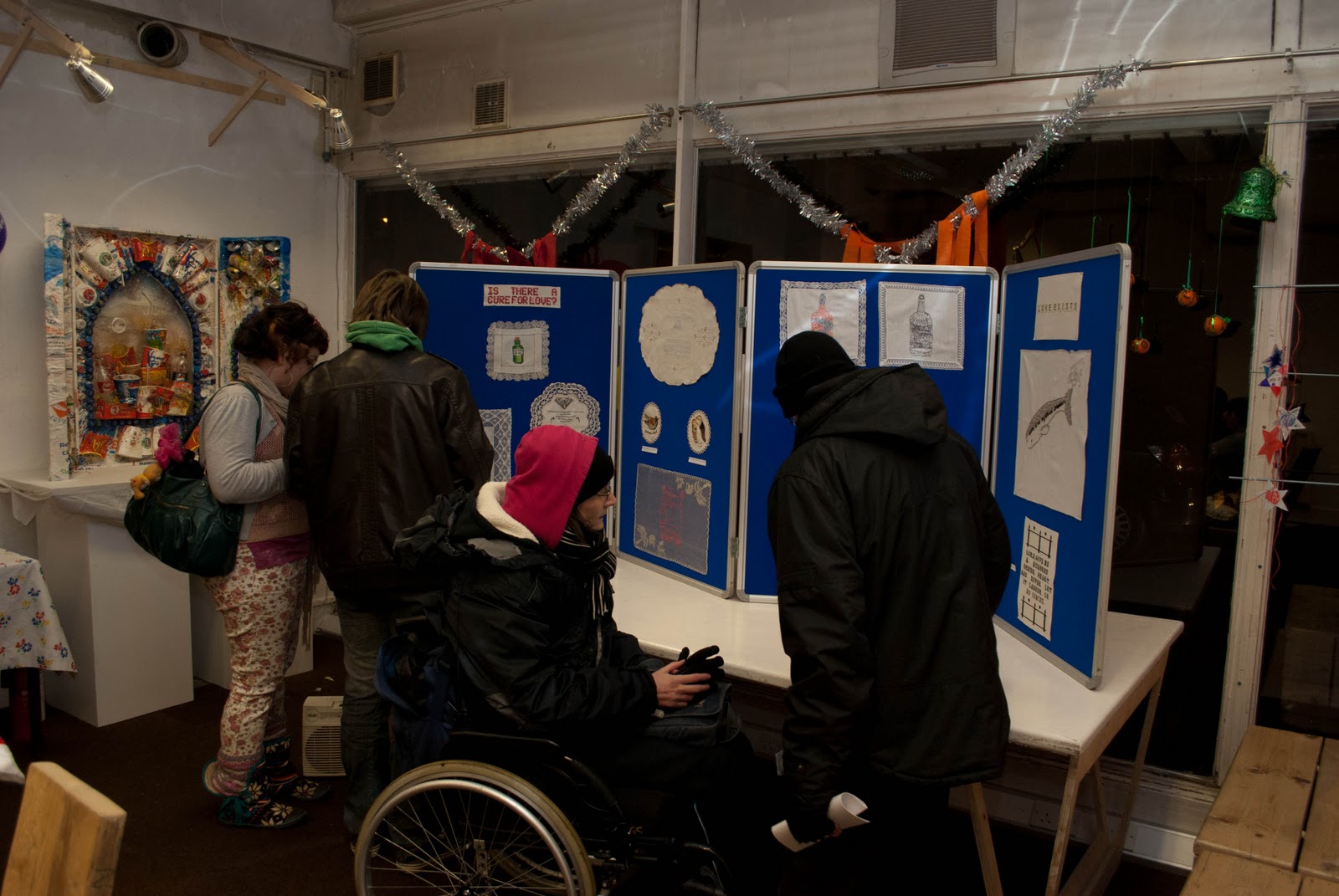


It was a lovely evening, and a very fitting end to The Cure for Love.

I suppose all that remains is for me to wish everyone a very Merry Christmas! Until next time (whenever that may be!)


Monday, 28 November 2011

"A Disparate Patch-work" - Writing and Sewing


In her essay Sew to Speak: Text and Textile in Eudora Welty, Geraldine Chouard describes the process of writing as "editing "with needles and pins," shifting and assembling textual fragments, in a fashion very similar to patch-work quilting."

Indeed, it could be said that my own writing practise is akin to "patch-work"; I have assembled the texts I have used in The Cure for Love out of various "scraps of material" garnered from different poems and short stories.

Not only that, but the various art forms explored throughout The Cure for Love (text, sound art, embroidery, and, in the near future, video) are combined together into a "patchwork quilt", comprising the project.

I almost always write, like Chouard, in "strips - paragraphs here, a section of dialogue, and so on."

Chouard goes on to explain that "A text is always a second-hand piece, made of words which have had a life of their own in previous arrangements, as are the fragments of a patchwork quilt which have served other purposes and which, stitched together in a particular fashion, form new patterns."

I concur; to paraphrase Cixous, when we write, we collaborate with all writers who have gone before us; all texts; all language.

Cixous writes of "a spokesperson I, the social I who votes, who represents me. I have an I who escapes me. I have an I who answers for me. I have an I who knows the law. The I who writes gives speech to all the other Is." Is this "I" not the same as Freud’s “ego” ?

The "speech" which the "I who writes gives (...) to all the other Is" is thus the canon of writing passed down to the "I who writes" over the passage of time. Through drawing this conclusion, Cixous arrives at an ideology in her own writing of never asking herself "who am I?" (qui suis-je?)", but instead asking herself  " “who are I?” (qui sont-je?)"
All writing, therefore, is patch-work.

"To speak is to thread and the thread weaves the world"

Liz Whitehouse introduced me to this gorgeous poem by Cecilia Vicuña (translated by Rosa Alcalá). Thanks Liz!


Word & Thread

Word is thread and the thread is language.
Non-linear body.
A line associated to other lines.
A word once written risks becoming linear,
but word and thread exist on another dimensional plane.
Vibratory forms in space and in time.
Acts of union and separation.
*

The word is silence and sound.
The thread, fullness and emptiness.

*

The weaver sees her fiber as the poet see her word.
The thread feels the hand, as the word feels the tongue.
Structures of feeling in the double sense
of sensing and signifying,
the word and the thread feel our passing.

*
Is the word the conducting thread, or does thread conduct the word-
making?
Both lead to the centre of memory, a way of uniting and connecting.
A word carries another word as thread searches for thread.
A word is pregnant with other words and a thread contains
other threads within its interior.
Metaphors in tension, the word and the thread carry us beyond
threading and speaking, to what unites us, the immortal fiber.
*
To speak is to thread and the thread weaves the world.

*
In the Andes, the language itself, Quechua, is a cord of twisted straw,
two people making love, different fibers united.
To weave a design is pallay, to raise the fibers, to pick them up.
To read in Latin is legere, to pick up.
The weaver is both weaving and writing a text
that the community can read.
An ancient textile is an alphabet of knots, colors and directions
that we can no longer read.
Today the weaving no only "represent," they themselves are
one of the being of the Andean cosmogony. (E. Zorn)
*
Ponchos, llijllas, aksus, winchas, chuspas and chumpis are beings
who feel

and every being who feels walks covered in signs.
"The body given entirely to the function of signifying."
René Daumal
A textile is "in the state of being textile": awaska.
And one word, acnanacuna designates the clothing, the language
and the instruments for sacrifice (for signifying, I would say).
*

And the energy of the movement has a name and a direction: lluq'i,to the left, paña, to the right.
A direction is a meaning and the twisting of the thread
transmits knowledge and information.
The last two movements of a fiber should be in opposition:
a fiber is made of two strands lluq'i and paña.A word is both root and suffix : two antithetical meanings in one.
The word and the thread behave as processes in the cosmos.

The process is a language and a woven design is a process re-
presenting itself.
"An axis of reflection," says Mary Frame:
"the serpentine
attributes are images of the fabric structure,"
The twisted strands become serpents
and the crossing of darkness and light, a diamond star.
"Sprang is a weftless technique, a reciprocal action whereby the
interworking of adjacent elements with the fingers duplicates itself
above and below the working area."

The fingers entering the weave produce in the fibres
a mirror image of its movement, a symmetry that reiterates "the concept
of complementarity that imbues Andean thought."
*
The thread dies when it is released, but comes alive in the
loom:
the tension gives it a heart.
Soncco,
judgement and reason, the wood's core, the stem's central
fiber.
The word and the thread are the heart of the community.
In order to dream, the diviner sleeps on fabric made of wik'uña.
is heart and guts, stomach and conscience, memory, judgement and reason, the wood's core, the stem's central
fiber.
The word and the thread are the heart of the community.
In order to dream, the diviner sleeps on fabric made of wik'uña.

Sunday, 27 November 2011

My exhibition at The Mill

If you're in London, I would love to see you there!

Love Potion Number 1

Remember the potion book I shared with you in a previous post? Well, I've spent the past few days stitching up the love potion from it (apologies for the long absence; I've had two friends to stay pretty much consecutively, and consequently have been quite busy!)

The tiny stitches are practically illegible; unintelligibility is a concept I have previously been interested in in terms of the spoken word in sound art; censorship, self-censorship, a lack of transparency of communication, stuttering, irritating modern-day “thinking aid” fillers such as “Yeah” and “Like”, etc. I think illegibility can sometimes work when done intentionally, for example in this case with the sprawling handwriting of young children, with its invented and secret languages. Also, it only adds to the mystique of potion-making!


Yesterday an aforementioned friend who was staying with me and I visited the Wellcome Collection in Euston, one of my favourite London galleries. The exhibitions are often a fascinating combination of art and science. The current exhibition  which I was most interested in, however, was a bit of a departure from the scientific side of things; titled Charmed Life: The Solace of Objects, it was curated by the artist Felicity Powell (who I think may just be my new favourite artist!)

Powell selected talismanic objects from the collection of Edwardian amateur folklorist Edward Lovett (which comprised 1400 amulets). Despite rising to the rank of Chief Cashier at the City of London's Bank of Scotland, Lovett had a keen interest in the superstitions of working class Londoners. He began collecting charms which these Londoners carried for luck or protection, amassing the huge collection from which Powell has drawn the exhibition.

The sea horses shown above, for example, were made in Venice and carried by Londoners to bring good luck.

A coil of wire from Ceylon with "length equal to the height of a person" was intended to ensure a successful resolution to any request by the person in possession of it. Alongside the wire were displayed "Gemstones of poor quality, given by Gem-miners", also intended to bring good luck.

One of the most aesthetically interesting installations was comprised of a huge selection of beautifully laid-out charms, votives, and amulets, to ward off "nightmares" etc. These included glass acorns, lucky horse-shoes, glass slippers, tin hearts, carved coral and bone, fossils, and metal crosses and phalluses. The (rather blurry and wonky)scan below shoes how this installation was laid out:


Powell also made work in response to the exhibition; ranging from an etched coin "Against insomnia, for sleep, against amnesia, for memory", with a scene of clouds gathered over the sea. This put me in mind of relaxation techniques for sleep; "whale song", and imagining that "you are on a beach..."

Powell's current practise mainly focuses on wax "amulets" carved into mirror backs. These dream-like scenes are evocative of folkloric art. The short films Powell had created for the exhibition truly captivated me; they were full of the illusion and "magic" with which the objects Powell curated were imbued. In one, Powell "strokes" wax on to a mirror back, and hands appear; in another, "beams" of coral-coloured wax dissolve into flames.

Sleight of Hand, video, 7 minutes, 2011

Folkloric art and charms is definitely a practise I will be looking into towards the time of my CAP (the final performance/installation/presentation of my degree). I feel it is relevant for The Cure for Love, however, due to my focus on love potions and seeking a "cure" for love.

Sunday, 20 November 2011

Blogged by Stitch Therapy

Stitch Therapy (aka Emma Parker) did a post on some very talented needlework artists, and included one of my pieces; I'm very flattered to be featured alongside the likes of Matthew Cox! Thanks, Emma!

Thursday, 17 November 2011

A Champagne (yet right-on) Socialist, and some blokes who sew

According to a 1908 biography of William Morris I picked up on my trip to Brighton, Morris (much like me) was "a born romantic". However, his romanticism was applied to "the hard facts of life"; he channelled his "sense of wonder" and "passion for beauty into the making of beautiful things which were eventually to become the starting-points for the wonderland of a new civilisation: in a phrase - the discovery of the romance of work." In short, Morris yearned for a socialist utopia in which great pleasure and pride was found in every type of work, and (in particular) in the decorative arts. 

This love of work is evident in, I think I can safely say, all the minor masterpieces of arts and crafts design that Morris and Co. produced.

William Morris
Morris wasn't merely a romantic artist and designer, however; as an article in the Socialist Review put it, he was "a socialist by design". He wrote pamphlets, gave speeches, edited two socialist newspapers, and was one of the first to join the Social Democratic Federation, in 1883.

In keeping with his socialist principals, "William Morris even envisaged a time when the sexual division within the domestic arts would vanish for ever. He anticipated the day when 'the domestic arts; the arrangement of the house in all its details, marketing, cleaning, cooking, baking and so on' would be in the hands of everyone"

In many respects, his dream has become a reality; no longer do domestic duties appear to be divided (quite so) strictly along gender lines. However, my dad may do the bulk of the ironing, but the cooking is still Mum's "job"; Dad lacks the confidence to try cooking anything more adventurous than his famous "baked bean shepherd's pie" (it's a culinary... experience).

As far as craft is concerned, more men do seem to be turning to the needle, although gender lines are more rigid here; Mum may do the majority of the DIY, but, at least in my household, it's the women who darn the proverbial socks.

"Manbroiderers" of the Jamie "Mr X Stitch" Chalmers ilk are trying to change this. I suspect the upsurge in male embroiderers is due to a few factors; the "invention" of the "new man"; the current vogue for all that is analogue and twee; and a similar vogue for the ironic and post-modern.

Throngs of men embroidering at craft nights, however, is something that, unfortunately, I've yet to see. It would be encouraging to have some brothers-in-arms!


Elusive male crafters at an East London Craft Guerrilla night

After all, there's certainly nothing effeminate about Chalmer's work; one of his most recent undertakings was a series of cross stitchings of the spam filtered out of his inbox, including the ubiquitous invitations to "sharpen your love sword"!


Richard Saja and "Johnny Murder", founder of the Manbroidery blog here on Blogger, are fellow male embroiderers. 

Richard Saja,  "... and a half-extinguished fire is soon relit", 2011
"Johnny Murder" doing his thing... bare chested... with a cigarette (very much putting the "man" in "manbroidery")

A section of male society who have taken to embroidery in force, perhaps surprisingly, is prisoners. Fine Cell Work is a charity which aims to "foster hope, discipline and self-esteem" through teaching British inmates to hand embroider. Their embroidery is then turned into cushions, bags, and patchwork kilts. The prisoners are paid for their work, and trained to a high skill level by volunteers from the Embroiderers and Quilters Guild, as the photographs below show:
Love Cushion, a Daisy de Villeneuve design embroidered by British prisoners
Beetroot design, embroidered by British prisoners

The enterprise is clearly vastly rewarding for the prisoners; Steve, an inmate at Wandsworth prison, is quoted as saying that he is "learning a new skill" which he "did not think possible. I also know that people do care about me and what I do because otherwise why would people take an interest in my fine cell work! I now believe what others think about me makes a real difference to how I conduct myself.”

However, it would be wonderful to see some more embroidery by un-incarcerated men! Come on guys! Get stitching.