I've just unearthed this old chestnut; it's a book of potions that my best friend and I made when we were wee. Thought it was appropriate seeing I'm giving a workshop making love potions next Wednesday! Think I will bring it along with me for inspiration (or perhaps just a giggle!)
There's even a love potion recipe:
The recipe reads:
Love Potion
Ingredients
1 small red rose
3 petals of poppy
5 buttercup petals
The air on which a first kiss was carried
Sugar and spice and all things nice
2 extra tsps sugar
pinch of salt
200ml water
Method
To start with boil the water. When boiled add sugar and spice and all things nice, extra sugar, salt, and rose. Leave to simmer for 5 mins then add air and crushed flower petals. Put in fridge to cool overnight - in morning you will have a love potion.
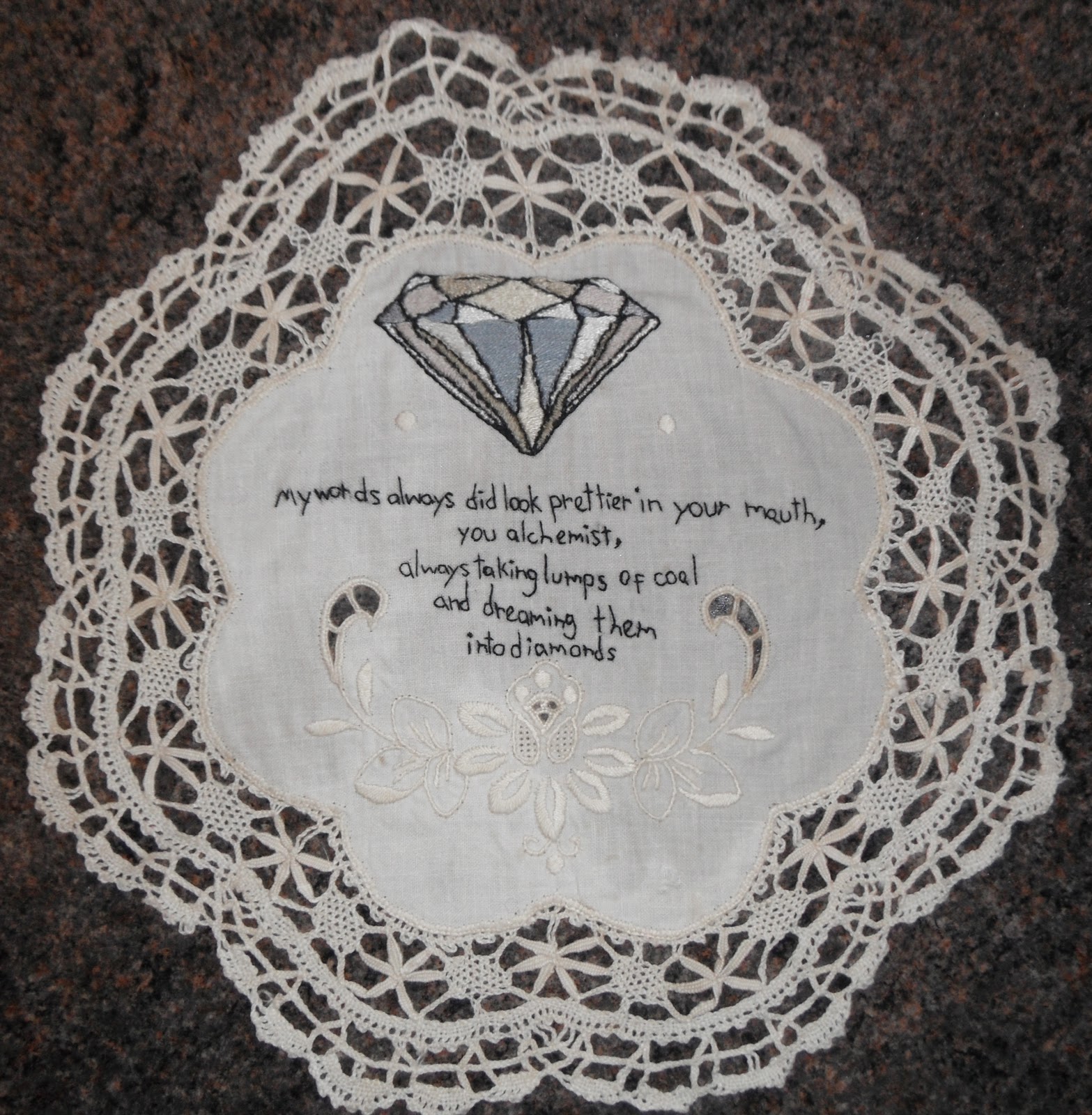
Here is my second collaboration with composer Joe Donohoe. This one, The Alchemist, has quite a different feel to Kiss the Book, in that it is brighter, both musically and in subject matter, being more of a "straight" love poem than the more cynical Kiss the Book. This time around I sent Joe the text of the poem and he composed out of that, recording my vocals afterwards. Joe used composing software to simulate tuned percussion and violins, and I think the results are very beautiful.
A few shots of the embroidery which accompanies the sound piece
The text of The Alchemist reads:
The Alchemist
My words always did look prettier in your mouth, you alchemist
Always taking lumps of coal and dreaming them into diamonds Making something out of nothing with the slightest
Sleight of hand or
Flick of the wrist;
You undid the buttoned-up British stiff upper lip at the collar,
Slipped that starched white surgical ruff off of the
Draft diamond, gave it room to respire,
A pause for a breather;
Then went mining beneath its varnished veneer,
Told me to take my medicine when i told you i belonged back in the coal scuttle, Only just no longer merely a minor, so why don’t you try her,
Before she slips back down the mine shaft to try for another?
I want to kiss you on the mouth; I want to kick you in the teeth, Oh take out your molars and string ‘em up into a necklace and
I’ll wear you always, strung up and strung out and resting soft as clouds of
Cubic zirconium all along my collarbones;
Oh boy you just about knock me out.
Today I am sewing my next piece (which will remain shrouded in mystery until it is unveiled), listening to a lot of angry girl music (such as The Horrorpops and The Dresden Dolls!), and checking out internships at The Tate. Got a few more collaborations on the way and very happy to be busy.
Much of what Joetta wrote in my interview with her chimed with my own thoughts on the process and connotations of embroidery, and with many of the contexts I am exploring through this project.
For example she wrote about the therapeutic quality of sewing, both metaphorically, in that sewing on fabric is reminiscent of suturing flesh, and literally, in that the quiet, meditative, repetitive action of embroidering soothes.
Joetta at work
(Just because I like to be contrary, I have to note that this, at least at first glance, appears to jar with the feminist artist and embroiderer Kate Walker's view that "passitivity and obedience (...) are the very opposite of the qualities necessary to make a sustained effort in needlework". However, in the interview Joetta goes on to write that, rather than using what is "thought to be a very passive form of expression" to "keep idle hands busy and docile", she uses her "hands and the medium to celebrate the vulnerability and strength of the female experience".)
A fellow blogging embroiderer and Londoner, Emma Parker, goes by the online alias of Stitch Therapy. The banner at the top of her blog states that "A stitch in time saves your mind".
I certainly found sewing both soothing and (thankfully) absorbing during my long recovery from an illness.
Emma's banner for her blog Stitch Therapy
Joetta also wrote that one of the things which first attracted her to embroidery was its history as a woman's craft. Joetta grew up around embroidery and craft, and, like me, grew used to seeing her grandmother sew from an early age.
As she began to incorporate embroidery into her practise, she relished its ties with the domestic and thus chose to embroider on vintage linens. Like me, she feels that previously owned linens "bring their own history of women's voices and hands as well as the history of the homes they have lived in".
However, as Joetta is a professional artist and sells her work, she feels uncomfortable sewing on "inherited fabrics", whereas I sew almost exclusively on linens passed down to me by my grandmother, thus adding another layer of historical and familial context to the Cure for Love project. Joetta, however, sews on acquired vintage linens, but in a subversive fashion, while simultaneously acknowledging "the roles of the home and intimacy within the identity of the modern female".
Though my intention in the Cure for Love project is not specifically subversive, I have created subversive embroidery in the past and imagine I will do in the future (particularly considering that a friend and I are now discussing creating a feminist zine... but more on that at a later date).
Don't Be An Art School Arsehole, an example of my slightly more subversive embroidery
Joetta also had some interesting thoughts about how "being feminist" does not mean "that you cannot embrace and choose to be feminine". She argues that the point of feminism is not "to force women to feel like they must do it all and succeed at it all and judge themselves on if they are being "feminist" enough". This nagging doubt is one I can relate to, as, being an artist writing and making art about love, I sometimes worry that I come across as some soppy dippy moonstruck teenager (which admittedly I am, save the teenager part). My current body of work is not overtly feminist, other than reclaiming a trivialised and traditionally feminine craft for contemporary purposes.
Drink Me In, one of my contemporary embroidered love poems reclaiming women's craft
Another of the points Joetta made is that autobiographical, introspective art (such as Tracey Emin's) is no bad thing, as it is often this that is most raw and universal. For example, Joetta's own work is about the universal experiences of "experiences of love, loss, joy, doubt, etc". This universal quality is something I aim for with the honesty of The Cure for Love.
Lots of interesting food for thought in my interview with you, Joetta. Thanks again!
Since Tina and I are holding a workshop exploring broken relationships, it seems appropriate for me to research a museum devoted to "the concept of failed relationships and their ruins".
The museum, which has been exhibited at the Tristan Bates Theatre in Covent Garden, resides in Zagreb, Croatia. It was dreamt up by artists Olinka Vištica and Dražen Grubišić, after their own relationship disintegrated (however, the pair remain friends, and celebrate the positive parts of their relationship in the museum).
The ex-couple
The idea came to the ex-couple whilst they were dividing up their possessions; they wanted to protect the memories held by the flotsam and jetsam of their relationship "from oblivion".
A wind up rabbit, one of the first exhibits in the museum, is a relic of Vištica and Grubišić's relationship; I (voyeuristically) wish I knew the story behind this memento.
Each exhibit is accompanied by details of the length of the relationship it signifies, the place in which this relationship took place, and a text written about it by the contributor. These range from the heartbreaking to the unintentionally humorous; for example one of those all-too prevalent gift shop teddy bears holding an "I love you" heart is accompanied by the text "WHAT A LIE! LIES, DAMN LIES!"
Such a shame that I missed the exhibition when it was in London. The concept puts me in mind of memento mori, or shrines to the dead; the exhibits in The Museum of Broken Relationships, however, are shrines to relationships that have died; a testament to the ephemeral. Love can be the most mundane or extraordinary experience, or often both at once; all aspects of love are displayed in the museum for public consumption.
And who wouldn't get a voyeuristic kick out of reading texts on lost love fraught with emotion, akin to the angsty and/or wistful pages of a teenage diary? Through placing these objects alongside their stories The Museum of Broken Relationships elevates them from the mundane to the sacred.
If you're in London on the 19th I'd really love to see you at The Mill in Walthamstow for a session of stitching love potions! Tina Buenoof The Pharmacy of Stories and myself will be hosting the night.
The Mill is on the left hand side of Coppermill Lane, which is the road which leads on from the very bottom of Walthamstow Market. The nearest tube station is Walthamstow Central. Hope to see you there!
I wrote this blog post on Joetta's practise back in late August, and now she has very thoughtfully and (hugely) thoroughly answered some questions on her work for me. Thank you so much Joetta! Your interview makes for an engrossing read.
Why and when did you begin embroidering? I began embroidering about 5 years ago while in graduate school. I was working to finish a previous body of work that I had been doing for a long time and wanted to do one FINAL piece freeing me to move on.
At the time I was experimenting a lot with medium and being quite conceptual about my medium choice. This previous work was based on an experience of trauma and I liked that embroidery could be a metaphor for healing both in the literal suturing act of the stitch but also the quiet meditative act of the process. I assumed that this would be a one-off piece, I had never embroidered before, but I ended up totally loving the process and got addicted. From then on I kept making excuses to keep working in embroidery. My background is as a photographer and I have no formal training in embroidery at all.
Comforts, 2008, yarn; an example of Joetta's earlier textile art
Why do you work in embroidery rather than another medium? How do your photographic and textile practises fit together? I love the history that embroidery brings to the table. It is often considered a female practice and my work is very much steeped in the female experience and the domestic space, so conceptually the medium brings a lot.
I am also attracted to the fact that it is essentially a "useless" craft; something done for purely decorative reasons(rather then a practice like quilting or knitting where you can make something utilitarian). The decorative nature of it places it in a category of leisure and pleasure that attracts me. To me being an artist is this; it is the privilege of being alone with your thoughts and then communicating them through your medium, leisure and pleasure. It also gives the embroidery the special place of being done simply for the joy of doing it.
Technically speaking I love how it is "hand made" and therefore the hand of the maker is so present in the work, i.e do they do neat careful stitches, or messy large stitches. I love how the hand made embraces the natural flaws that exist.
I utilise my photography as the inspiration and source for my image based work but when I was asked this once before this was my answer: I fell into embroidery as an artist. In graduate school I decided to make a piece with embroidered text, because I liked the idea of embroidery as a metaphor for healing.
Unexpectedly I fell in love with the process and medium; while trying to figure out the next direction for my studio practice and work I began to explore embroidery as a medium of expression.
The medium felt very natural to me as I grew up around fabric and crafts, through my mother and grandmother, and my work had always been made from an overtly feminine point of view.
As my new work began to grow and my love towards the process of embroidery deepened I began to enjoy the subversive quality of the medium, how what was expected from a hand made embroidered piece could be so easily manipulated and yet the viewer always comes to it with the same expectation. I began to utilise the expectation of embroidered works and domestically placed linens to further my concept of exploring the roles of the home and intimacy within the identity of the modern female.
This Is Bullshit, date unknown
I was particularly drawn to how traditionally embroidery was thought to be a very passive form of expression done simply for decorative purposes but through my hands I could use the medium to give a voice to women. Instead of subverting that voice by keeping idle hands busy and docile, I used my hands and the medium to celebrate the vulnerability and strength of the female experience.
As a photographer, I mostly spent my time thinking about what I wanted to capture, and then, since I work mostly through a form of documentation, having the patience and awareness to capture that moment as it arrived. My camera was always loaded and ready to still the moment of light and life that stopped my eye. Embroidery has completely transformed my studio practice. I now spend hours and hours in my studio slowly building my work upon a linen, surrounded by thread and piles of linens and fabrics, working in a very tactile way where as when I do photography my tactile senses are not as satisfied.
Even though photography is a very fast medium, taking only a 1/15 of a second to capture your image and less then 5 minutes to print it, and embroidery is a very slow and labor intensive practice, I do not find them as different as you may expect. They both require immense patience; in embroidery the patience is in the labour intensive practice and in photography it is the waiting for the light or the right expression. They both allow for a significant amount of quiet, contemplative time. As a photographer you spend hours in a dark quiet room all by yourself waiting for your paper or film to develop, going through the same simple repetitive steps to get your print, and in embroidery you repetitively make the stitch, working hour upon hour, lost in your thoughts and quiet as your work slowly builds.
I love that both mediums leave me so much time to meditate upon the images that I create. Though the mediums seem quite dissimilar in practice, they actually share quite a bit.
After They Left, 2008, C-print; an example of Joetta's photographic practise
Why do you work on such a large scale? I have always liked working on a larger scale- I like how one can enter the work and physically relate to it more this way. I also enjoy how one can experience the work in a different way from far away and then up close.
What leads you to choose a particular word to embroider in your text pieces? My emotional space. Initially my text works were diaristic statements; as a life-long diary keeper I just started to embroider my statements instead of write them. Then I went through a process of writing cathartic statements, things I felt like I needed to say out loud and make tangible. Now I am interested in honoring experiences and moments. But in general they are statements that come to me in my daily life and I catch them and put them into a work.
Be Strong, 2009, one of Joetta's text pieces
Do the fabrics you use to sew on have any sentimental value?
They are all found fabrics. I have worked with inherited fabrics but since I sell my work I do not feel comfortable doing this anymore. But to me the fabrics still have sentimental value in the sense that someonemade them, someone took the time to embroider lovingly onto them, or add tatting to their edges, and they lived a life in someone's home. I love the stories they tell; are they pristine and preserved, are they stained and used, are they rotting and disregarded, are they unfinished... All stories can relate to our relationships and homes and I try to make the linens make sense with the final work that is stitched onto them.
Why do you choose to embroider on found, vintage linens?
As I have said before, they bring their own history of women's voices and hands as well as the history of the homes they have lived in. I feel like I am giving voice to this.
Some feminists would be disparaging about celebrating the domestic role, whereas you say you wish to connect with a domestic lineage. Do you think the domestic is solely the prerogative of women, or do you think a man could produce work like this? I do not think that a man and could produce work exactly like this but do think a man could produce work about the same subject from a different point of view. When I exhibit my work it is often the male viewer that is most moved and touched by my work. Historically speaking the domestic is the domain of the woman and therefore my relationship to it as an identity, place, and role is different then a man's.
I do not know that I am "celebrating" the domestic "role"; I am more investigating what occurs within the confines of the home and the relationships, moments, and emotions that are held here.I am interested in the complicated roles that contemporary women must play.
I do get frustrated at how the roles of being a homemaker and mother are looked at as not enough and not feminist. To me the idea of feminism was to give women the option of choice, giving them the opportunity to do whatever they wish. It was not to force women to feel like they must do it all and succeed at it all and judge themselves on if they are being "feminist" enough. I also do not think that being feminist means that you cannot embrace and choose to be feminine. I do think that in general men and woman are different and think that celebrating our differences and embracing all of our sexuality is a good thing. I am a very strong and independent woman but I also love nurturing my son and honouring my husband and do not in any way think that these things need to be mutually exclusive.
The domestic space is not a space for only women but it is the space of the family and intimacy; this is what my work is about.I simply embrace the history of that space and the fact that my point of view comes from being a woman.
Eight Months, 2011
Why do you choose to focus on yourself and your family as the subject of your work? Some might argue that this is rather introspective! I have always worked autobiographically and have always been drawn to other artists that do this. I once heard a writer talk about writing and they said that "you have to write about what you know". What I know is my life and my experience so this is what I make art about. I like art that has a raw honesty to it so the only things that I can be truly honest about is me.
With that said I do no think my work is so specific; what I actually makework about is universal experiences of love, loss, joy, doubt, etc... I think that often the more personal you let yourself become the more accessible the work becomes.
And I would never take being introspective as a criticism. I think that many could benefit from being a little more of this.
In addition I think art in general is a somewhat narcissistic act no matter what you make. You are making something to express your point of view on something and communicate it. Being this is part of being an artist.
Have you considered combining text and image together more often?I have. This is something I have been wanting to do more of for a long time. But I work very intuitively and so far the work has for the most part stayed separate- though it is always exhibited together.Generally my image based work is about one side of intimacy and love and my text work is about the other so often they need to exist as separate works that have a conversation within the gallery. But I imagine more combining of these will come as I continue to make work.
Waking With You, 2010, a piece in which Joetta combined text and image