Tuesday, 14 May 2013

Gold Star

As a habitual pessimist and anxiety queen, I have recently begun keeping a record of one good thing from each day, to remind myself that actually, my life is pretty darn good.
 
I've also been indulging in an incredibly childish (and mildly embarrassing) practice; giving myself reward stickers.
 
A few months back, on the advice of friend, collaborator and fellow artist Hannah Hill, I started keeping a record of daily to-dos and achievements as a means of patting myself on the back (something I'm often not very good at) and as an impetus to get stuff done. I nicked Hannah's idea and added reward stickers, and as I noted at the time, self-imposed bribery to do things via a stickers-based reward system worked (un)surprisingly well. Yes, I am a child.
 
There's something about gold reward stars in particular that is incredibly crave-inducing; they must be engineered that way. Maybe its my innate and irritating perfectionism, mixed with nostalgia for primary school, I don't know.
 
Anyway, in homage to the humble gold star reward sticker, I wanted to make a series of work celebrating the minor achievements of us bumbling humans as we muddle our way through life, making it up as we go along and getting bumps and scrapes which (hopefully) only serve to make us a little bit stronger... I'm bumbling myself now.
 
I'm tentatively calling the project Treasures For Your Troubles, which is what the first embellished piece of the series spells out, in (what else) golden star sequins.


The next element of the project (which will be a multimedia undertaking) will be accomplished with the aid of my trusty old Polaroid Spectra camera, and some Impossible Project film which I was happy to find had arrived when I got in from work this evening. Now if only we'd have some good weather, I could get on with it! Just one of the (very minor) obstacles in life the project is all about overcoming.

Wednesday, 8 May 2013

Lunar Moth


You may have noticed by now, I have something of a predilection for moths.  As The Constellation Quilt is all about stars and the night sky, I couldn't help but stitch up a lunar moth as one of the quilt patches. And as Polly Kettle, the quilt's subject, is something of a femme fatale, I stitched a female lunar moth (the female of the species's colouring is more in line with the toning of the quilt, too!)

I don't know if anyone else has this experience, but this embroidery was one of those ones for me where I've been working on it so long I can't tell if it's any good or not anymore, and truth be told I think I'd still like to have a little play at perfecting it, and adding more realistic and subtle shading. Whether I actually will is another matter; I've got too many new ideas to plough on with, including more floral-themed blackwork and a project about gold reward stars...

Saturday, 4 May 2013

Interview with Lindsay Joy on her "Anxiety Series"

I did this interview with incredible fibre artist Lindsay Joy for a side project many months back, and since I've been chatting to Lindsay quite a lot on Tumblr recently, and following her work more closely, I thought I would share it here.

Lindsay is currently undertaking her Master of Fine Art at the University of Manitoba in Canada, and describes her practice as "scrambling attempts to feel better", which I'm sure all artists can relate to at one point or another!

Thank you so much for doing this honest, insightful interview, Lindsay, and thank you for letting me share it here.


What prompted the Anxiety Series? On your website you write that you realised “the most helpful therapy was the act of sharing”. Was your hope that your Anxiety Series would offer comfort and a sense of empathy to others suffering with anxiety and social phobia?

I have always been an anxious person, but two years ago I started realizing how much it was affecting my life. I started seeing a psychologist during the summer before my fourth year of college.  One of her suggestions was to make contemplative art as a way to calm down. At first, I tried the usual stuff - journal entries, a painting, earnest assignments that were embarrassing to show anyone but her. I didn’t feel like they were helping; I was just making what I thought I was supposed to. Traditional “contemplative art” also suggests wacky new age stuff which, as a skeptic, I am completely uninterested in.  I picked up embroidery again after my grandmother passed away, which happened right about the time my anxiety was at its worst. We found some antique hoops in her apartment, and I was antsy, away from home, dealing with grief and needing something to do with my hands. I made a small piece called Matriarch, reteaching myself how to stitch after not doing it for a long time. Once school started up again and it came time to really develop my art practice in my final year, I decided to use embroidery to explore my struggle with anxiety.

When I first realized I had a problem with my anxiety, finding out that Social Anxiety Disorder is a real thing in the world (at least according to Wikipedia), I tried to tell a few people. It was a terrifying revelation, and for some reason sharing was helpful, because it meant it wasn’t my fault. THIS is what’s wrong with me, guys! THIS! I got some strange responses, though, probably because I didn’t tell the right people. I have a hard time negotiating personal relationships in that way. When I started making the anxiety pieces, it was like they were a surrogate for my own confession, and though I didn’t necessarily know the recipient and they didn’t know me, but I still got to tell someone how I felt. At first, I was actually surprised that other people could relate, especially people I knew.

a9

Is there something about the juxtaposition or conflict between the cutesy or twee aesthetic of embroidery and the darker elements of your subject matter that you find appealing?

I’ve always found that juxtaposition intriguing. It makes my work feel less of a teen-angst expression and more self-aware. It’s also the fight in my own head, knowing that my thoughts are ridiculous but not being able to stop them. Reframing them with cutesy imagery, stitching and colours might create a sort of trap, drawing the person in from afar to view my detailed handwork, maybe expecting a laugh, but confronting them with the subject matter.

a2

Why and when did you begin to embroider? What sparked your interest in embroidery?

I’ve always made things with my hands. My mother  knits, crochets, embroiders and quilts, to name a few. I was an only child, so she showed me a few things when I was bored growing up. I used it a few more times during my first and second year of art school, where I majored in fibre and tried a lot of techniques. I was drawn in by the way you could combine colour, texture and line, and the ease of image appropriation with the technique. With embroidery, it is easy to be direct. With a lot of other textile techniques, you are waiting for dyes or to thread your loom, and I can just start stitching something right away. I am impatient, although that’s probably an ironic statement. I love the history of hand stitching, which also has a history with mental health, often as a past-time in institutions. 

Has making the Anxiety Series been a way of reaching out to others in the community? Have you been contacted by other sufferers?

I haven’t really been contacted by severe sufferers, but more from people who could relate to some aspects of the work, not necessarily having full-blown anxiety.  

Was it difficult to put such an intimate and painful aspect of your personality on display? What was the public reaction to the Series?

It wasn’t difficult at first, because I began the series during school, and the fibre group was so small and intimate, that I didn’t feel afraid to do it. Once it started to reach a larger audience, I became a little nervous about it. During the graduating exhibition, I was too afraid to be near-enough to my grad piece for anyone to identify me as the maker. With the work, I sometimes have had better responses from strangers than people I was close to. I’ve received a lot of concerned, “But you shouldn’t feel that way,” comments from friends I had known for years, and bad advice for quick fixes. I incorporate some of that into my work, too. The hardest thing, now, is to explain when I meet new people who are interested in finding out what I do as an artist. I think they have some degree of skepticism, like, “How can you be anxious?  You are talking to me now!” or something. The funniest thing was a classmate called me up to ask about an assignment, right after she had seen me working on the phone piece. Halfway through the call, she said, “Oh no!  You hate talking on the phone!  I’m so sorry!” It’s a little weird having people know those things, sometimes.

b10

Was the act of confession, together with what Joetta Maue calls the “quiet, meditative act” of embroidery, therapeutic?

It started out as the intention, although the anxiety is always there. A few people have assumed that since I’ve made the work, I’m anxiety-free, which is kind of weird. The work is definitely a temporary fix.  Thinking about what thread to use next and where to put the stitches sometimes helps when I’m thinking too much about useless things.  It keeps my mind occupied.

Friday, 3 May 2013

Thinking Through Pink


When we were kids, one of my brother's favourite colours was pink. I, on the other hand, loathed it; a rebellion against the ubiquity of the colour for little girls, and a loyalty to my tomboy nature (I was the girl always climbing trees and enthralled by creepy crawlies). Where did it all go wrong? Why do I now own at least seven pink dresses, and am happy to be snapped prancing around in a salmon candy-striper frock?


My parents tried all they could to evade gender stereotypes (my beloved bright yellow Tonka truck attests to that), but it seems I've waltzed right into one; I've turned out decidedly girly. And what do I blame this disturbing phenomenon on? Why, on the young modern feminist art movement, of course!

Tumblr is awash with young feminists "reclaiming their girlhood"; as Beth Siveyer, founder of Girls Get Busy, writes in the fourteenth issue of the zine, "I can be strong and feminine, and it doesn't matter what people think (...) I'm 24 years old and I'm finally ready to be pretty in pink."

Image of Girls Get Busy #14 - 3 for £3

When I was discussing this with my Mum the other day, she commented that she'd recently had to buy some gardening gloves for a group of young people she would be working with. The gloves came in two colours; pink, and blue. In the end she had to go with the blue gloves, because, she conceded, the boys in the group simply wouldn't wear pink gloves. I'm inclined to think that this would not be because of an aversion to the colour, but an aversion to what the colour represented; an aversion to perceived femininity. Why is femininity so reviled? Why is "stop being such a girl" such a terrible insult? 

I would hazard a guess that it's because, historically, women have been the second sex, subjugated and weakened by a patriarchal society determined to keep men on top. This has lead to the impression that women themselves are intrinsically weaker, and so "feminine" behaviour is a sign of weakness. One need only take a glance at the Everyday Sexism Twitter feed, a deeply depressing but vital read, to realise that we are a long way from gender equality, and that a culture of "keeping women down" is still a very real and present danger (and I don't use that word lightly).

But, as Beth Siveyer writes, femininity can be a source of power. So too can pink. It is an audacious colour, a passionate colour, a sexual colour. A colour as varied as women themselves.

DENIM Feminine Is Not Anti-Feminist Patch featuring Rarity- My Little Pony
"Feminine Is Not Anti-Feminist" patch, by albinwonderland on  Etsy

However, pink can also be nauseating. Case in point, that ubiquity I mentioned; now more than ever, it seems there's almost no other choice for little girls than pink clothing, accessories, toys... the list goes on. As this article notes, "All the other colours of the rainbow will be washed away in an unending saccharine sea."

The backlash to this trend has resulted in the Pink Stinks campaign, focusing on combating the "dangerously narrow definition of what it means to be a girl" and the ways in which "pinkification" of girls leads to sexism and gender stereotyping, and an obsession with consumerism and body image.

 In my opinion, this is most certainly a laudable cause, though the name of the campaign does sound like an assault on the colour itself, rather than its use as a reductive marketing tool. A member of the modern feminist movement makes the suggestion (via Tumblr, of course) that the Pink Stinks campaign changes its name to Rethink Pink. Though this is a subtle change, I think it is a wonderful one; one can remain critical and aware whilst embracing the colour, that, for better or worse, has come to symbolise femininity.


It was not ever thus; indeed, in the early 1900s in the United States, a trade publication proclaimed that "The generally accepted rule is pink for the boys, and blue for the girls. The reason is that pink, being a more decided and stronger color, is more suitable for the boy, while blue, which is more delicate and dainty, is prettier for the girl." It is interesting that here, pink is associated with strength, just as I posited that pink can be a powerful and audacious colour. However, strength is associated with masculinity and delicacy and daintiness is associated with femininity; why can't one be both strong and dainty? This combined strength and delicacy is what I feel I emanate when I choose to wear pink.

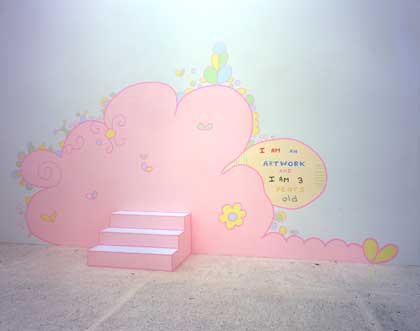
By a happy coincidence, one of my very favourite artist's thoughts on the matter chime precisely with my own. In an interview, Lily van der Stokker speaks about "the strength of pink curlicues"; there is strength in this apparently "weak" feminine softness.

Lily  van der Stokker, I am an artwork, 2004

But is it softness? For all its sweetness (indeed, because of its sweetness) van der Stokker's use of pink is nauseating, even abrasive. Pink can be harsh, abject, confrontational. It demands to be seen. Van der Stokker is certainly not ashamed of the femininity that pink implies, even if it horrifies the fine art bubble; she unabashedly proclaims girlyness to the world. 

A show of strength indeed.

I too, am happy to proclaim my femininity to the world, and to prove that it does not make me weak but in fact stronger. Since becoming more involved in the young feminist art movement, a number of my embroideries have started to explore themes of feminine strength, defiance of  gender roles and societal expectations, and incorporate pink into their colour scheme as a symbol of this.


I will continue to wear pink with pride and as a reminder of my feminine fortitude; I too am ready to be pretty in pink.

Tuesday, 30 April 2013

Two features on embroidery blogs in two days!

(Well, almost two days!)

Since coming back to the Flickr and Blogger folds, my blackwork commissions of treasured childrens' storybook illustrations have been getting rather a lot of love.

First they were featured over at the &Stitches blog on Sunday:

And today they were featured on Mr X Stitch's "Too Cute Tuesday" post by the wonderful blogger Olisa Corcoran (aka cocoaeyesthestitcher):


The response to these pieces has just reconfirmed for me that delicate blackwork is what I should be focusing on right now... I'm working up a little series, and will hopefully exhibit them in the summer. Here's the first of the series:


Monday, 29 April 2013

Nothing But Flowers


After weeks of stitching (and distractions), my Melancholyflowers are finally all stitched up! They're based on an illustration from the turn of the century childrens' book Land of Play - Verses, Rhymes, Stories, first published in 1911.

I've so enjoyed embroidering these delicate little flowers, although their intricacy did make it a frustrating process at times! I shall have them framed soon and look for somewhere to exhibit them along with the other embroideries in the blackwork series I'm working on. But for now, back to work on The Constellation Quilt.


Friday, 26 April 2013

An interview on the origins of Poesie Grenadine

Recently I've been contacted by a number of different students wanting to interview me on my practice as it relates to feminism, writing, and fashion. It's a real pleasure to answer their questions (not to mention immensely flattering!), and it wasn't very long ago at all that I was bothering artists Joetta Maue and Iviva Olenick with a plethora of nosy questions for my own projects.

This interview was with a fashion journalism student who is creating a literary magazine which focuses on the marriage between poetry and fashion. I'm very excited to see the finished publication.

What came first - your love for writing or your love for sewing?

Writing came first for me. I struggled with literacy at school, but after receiving my first "proper book" (with chapters!), Horse Pie by Dick King Smith, in my stocking, one Christmas when I was seven or eight, it was like turning on a tap; the writing just poured out of me.


When did you start doing each?  Why?

With the writing, the more I put in, (in the form of novels, poetry, non-fiction, plays) the more continued to pour out of me; this continued from the Horse Pie incident and hasn't really stopped, although my writing is a lot more pared down and concise now, as it often has to be embroidered, and embroidery is a very time-consuming medium! Aside from GCSE Textiles, when I embroidered a dress I'd hand printed with unfurling fern designs, I began embroidering in earnest after a very debilitating period of mental illness three years ago, as both an occupation and a form of therapy; I found the meditative, repetitive process soothing; perhaps I was stitching my ego back together again. Occupational or art therapy, if you will!

Are there any themes (in your writing and sewing) that you constantly use in your work?

As the above may hint at, I'm particularly concerned with public (mis?)conceptions of mental illness, notions of romance (and romantic notions), pop fem(me)inism, flora and fauna, the tortured artist cliche, sickness and recovery, the English national psyche, and art which is soft, twee, delicate or "girly" as a foil to darker subtexts.


Where do you get your inspiration from?

The online embroidery and feminist art communities are a constant source of inspiration and support, and I am very grateful to them, and to the web for making them so accessible. I try to take in as many exhibitions as financially possible, and, as it did in my formative years, my reading material continues to inspire me in wonderful ways. Being in nature is, in my opinion, also really important for the creative process, and helps me breathe.


What's your creative process like?  I.e. Do you find yourself writing first and then applying that to your stitch work?

The seed of an idea for an embroidery often begins as a scribble in a notebook, or, more often than not, as a note saved in my phone! There's always rather a lot of writing and planning done before I "commit to cloth". Documentation and reflection is a very important part of my creative process, and I do this by blogging over at http://poesiegrenadine.blogspot.co.uk


What is the significance of words on clothes/accessories for everyone to read?

Words on clothing will always make a statement about the reader to passersby or the general public. Why else do people buy branded clothing than to broadcast their affluence and sophistication to the world? Similarly, my brooches convey pride in oneself and allegiance to a feminist (or femme) cause; a pride in one's womanhood.


So far, which item that you've sewn has been your personal favourite?  Why?


 It's very difficult to pick an absolute favourite embroidery I've sewn; of the embroidered accessories I've created, my "Thunder Thighs Are Go" heart shaped brooch, with its play on the Thunderbirds catchphrase and body positivity, has proved a firm favourite with the Tumblr crowd and is a favourite of mine too (I may have to make myself one to keep!). I'm also rather fond of my Stitch Witches rosettes, created for my collaborative project Stitch Witches, which is soon to culminate in a zine celebrating contemporary and subversive stitch craft, curated and created by an embroidering girl gang of two.

CUSTOMISABLE Stitch Witches Rosette


Is there one in particular you believe to be most powerful?  If so, why is it?

People have really embraced "Thunder Thighs Are Go" as their own phrase to celebrate their bodies, and I'm moderately proud of that. I think that makes it quite powerful. Some of my embroideries on the subject of mental health, created in bitter and knowing irony, have been taken literally and reclaimed as a badge of honour, and I think either taken in this reading or in the spirit they were originally intended, they are powerful statements of defiance.


Describe some of the word play you use. 

My work is always underpinned by the written word, whether that be by beautiful etymologies, dreadful puns, or linguistic philosophy (though it is a little heavy on the puns!)

Currently, how many different projects do you have going on?
 
I'm currently taking a break from my most ambitious project yet; a hand made quilt on the subject of the stars and fortune telling, based around my character Polly Kettle, an occult siren. Whilst I'm ruminating on that, I've embarked on a blackwork series of turn of the century childrens' book illustrations. I'm also working towards bringing out the first issue of Stitch Witches zine with my collaborator Hannah Hill (http://hanecdote.tumblr.com/). 

When you created your first piece, what were the reactions like from other people?

The people to see my first piece of embroidery were my parents, and I think they were tickled by the playful wordplay and clumsy stitches! Considering how amateurish it is, it's received a surprising amount of attention on Flickr.


What are your hopes for your creations in the future?

This September I will be starting the tutor training course at the Royal School of Needlework in Hampton Court Palace, to learn, practice and teach hand embroidery to the highest possible level. In addition to and because of this, I would hope to exhibit my work more widely, and expand my practice of participatory performance embroidery workshops, social events where I use embroidery as a tool to open up conversation on a theme in a fun and performative setting.

By the way, where did the name Poesie Grenadine come from? 

Poesie Grenadine is a French phrase which translates roughly (and very broken-ly) as "purple prose". As much of my earliest embroidery arose out of re-workings of terrible teenage love poetry, it seemed most apt. I'm also somewhat of a florid, pinkish person, so it's suitable in that way too!